
There’s a gentle thrill in rescuing a tired hardcover and turning its pages into something unexpected: a sculptural heart, a skyline of peaks, or a hidden word that appears when light grazes the paper. The Art of Book Folding for Unique Home Decor celebrates that transformation, blending patience, geometry, and a little theatre to make books live beyond their bindings.
Why book folding matters now
We live in a moment that values things with a story, objects that hint at time and care. Folding the pages of a book reclaims narrative in a physical gesture; each crease preserves a moment of attention. The result is home decor that feels crafted rather than purchased, an immediate conversation starter on a shelf or mantel.
Beyond aesthetics, book folding is accessible. It doesn’t demand a kiln or expensive materials, and it welcomes people who like working with their hands but aren’t comfortable drawing or sculpting. That accessibility explains why the craft has quietly spread from libraries and thrift shops into living rooms and wedding aisles.
History and evolution of page folding
Turning books into art isn’t entirely new—the practice echoes centuries-old traditions of altering books for new uses, from recycled bindings to altered-book art that emerged in the late twentieth century. What feels contemporary is the codification of folding methods into repeatable patterns and the shared online libraries of templates.
In the past two decades, hobbyists refined techniques to allow precise, repeatable designs: folded words, silhouettes, and three-dimensional sculptures that rely solely on page folds rather than cutting. Social media helped accelerate innovation, with makers sharing patterns, time-lapses, and tips that pushed the craft from solitary practice to community-driven evolution.
Materials and tools you really need
At its simplest, book folding asks for a used hardback, a ruler, and a way to mark measurements. Add a few inexpensive tools and your accuracy and comfort soar. Choosing tools that fit your hands and habits keeps the process enjoyable rather than frustrating.
Here’s a compact table to help you decide which items to buy first and which can wait until you’re ready to refine your technique.
| Item | Purpose | Recommended spec |
|---|---|---|
| Hardcover book | Base material | 300–700 pages, tight binding |
| Ruler (cm and inches) | Measuring folds accurately | Metal or sturdy plastic, 12–18 inch |
| Bone folder or scoring tool | Creasing pages precisely | Bone, plastic, or wooden |
| Pencil and eraser | Marking fold points | Hard pencil (HB–2H) for faint marks |
| Binder clips | Hold sections steady | Small and medium sizes |
Choosing the right book
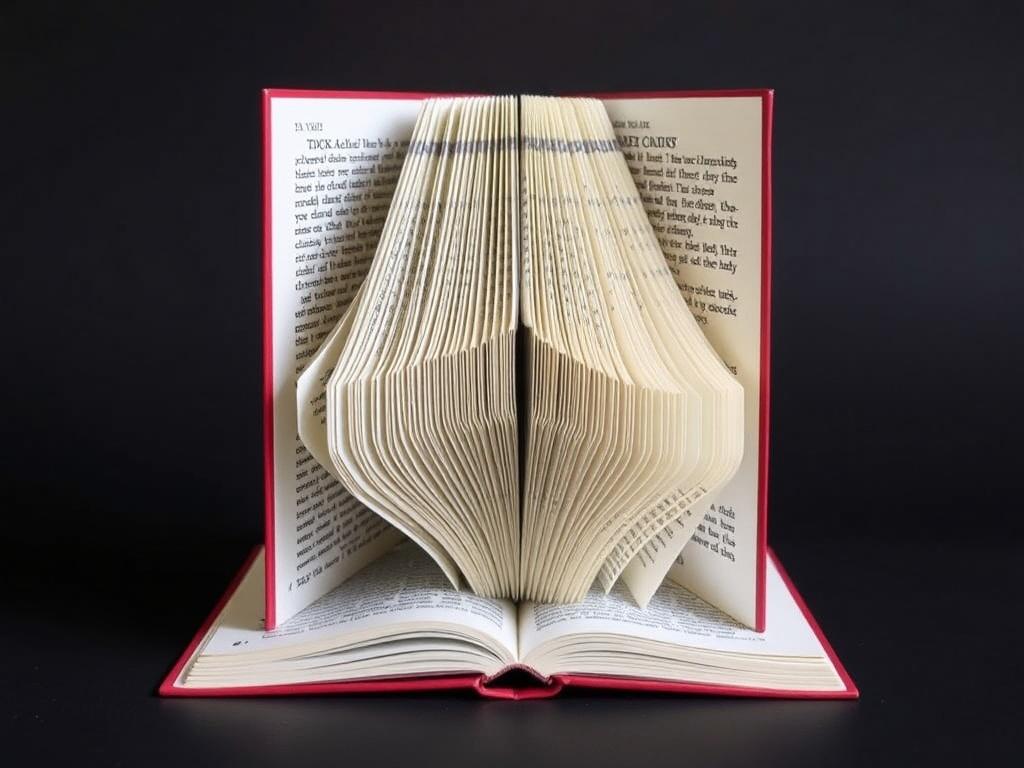
Not every book makes a good candidate. Thickness, page quality, and binding strength determine both the ease of folding and the final appearance. Aim for books with consistent page sizes and a well-sewn binding; glued or paperback spines tend to fail as the fold count increases.
For beginners, a book with 400–600 pages feels like the sweet spot. It offers enough surface to form letters or shapes without overwhelming measurement steps. If you prefer delicate, airy shapes, a shorter book with thicker paper can yield bold, sculptural folds.
Fundamental folding techniques
Two basic ideas underlie most patterns: the point fold and the valley fold. A point fold creates a raised ridge toward the book’s fore edge; a valley fold draws the page inward. Combining these, you can suggest depth, shadow, and outline.
Consistent measurement is the craft’s heartbeat. When numbers slide, letters blur and silhouettes lose their crispness. Work slowly for the first few folds of a pattern to set a rhythm, and use small binder clips to keep sections aligned as you progress.
Point fold step-by-step
Mark two points on the top and bottom of a page using the pattern’s distances from the spine and fore edge. Fold each mark to create a triangular ridge that protrudes from the edge. Press firmly with a bone folder to make the fold hold its shape.
Repeat across the page, aligning each ridge vertically. The staggered repetition of many such ridges builds silhouettes and letters when the book is slightly fanned open. The technique rewards patience and steady hands.
Valley fold step-by-step
Measure and mark two points similarly, then fold the page inward so the marks meet. The fold will create a hollow or recessed area on the book’s edge. Use a bone folder to push the creases tight, which helps the design develop clearer negative space.
Valley folds can pair with point folds to create sculptural contrast—raised edges against shadowed hollows. Designers often combine both to mimic depth in landscapes or faces.
Reading and using patterns
Patterns are the blueprints of book folding. Some are simple: two numbers per page telling you where to fold. Others map complex curves, requiring calculations across the book’s page count. Learning to read a pattern is a necessary skill and a small mathematical pleasure.
Begin with patterns that show the total page count required and a sample spread of the first ten to twenty pages. These previews reveal whether your book’s thickness suits the design. Over time you’ll be able to estimate adjustments without always checking the template.
Common pattern formats
Fold charts typically come in three flavors: single-fold charts (two measurements per page), multi-fold charts (three or more points per page for layers), and pixel-style charts where each page becomes a tiny segment of a larger image. Each format affects time and precision differently.
Single-fold charts are ideal for words and simple shapes. Multi-fold patterns can create shading and overlapping forms. Pixel-style patterns require many pages and exact counting, but they can reproduce intricate silhouettes and portraits.
Designing your own pattern
Creating a pattern begins with a sketch, then mapping the sketch to the book’s page count and height. Grid paper, graphing software, or simple spreadsheets can turn an image into fold points. Expect a bit of trial and error the first few times.
Start small—design a single letter or simple symbol to understand how curves translate into folded edges. Once you’ve confirmed the visual language, scale up to multi-letter words or compound shapes. Patterns become easier to calibrate with each project.
Translating an image into fold points
Convert your image to black-and-white and overlay a vertical grid equal to the book’s page count. Each column corresponds to one page’s fold location at top and bottom. The height of the black area tells you where to fold relative to the page top and bottom.
Software like spreadsheets, image editors, or free pattern generators can automate much of this mapping. But making a few patterns by hand builds your intuition and helps you recognize when an image will or won’t translate well into folded planes.
Step-by-step: fold a simple heart
This is a small project I recommend for the first non-practice piece: a heart that sits centered when the book is closed. The shape is forgiving, and the symmetry helps you notice measurement errors early on. You’ll end up with a charming piece suitable for a shelf or a wedding table.
Choose a book with 400–500 pages. Download or sketch a heart pattern with two measurements per page that reflect the heart’s outline. Ensure the centerline of the heart aligns with the book’s middle page to avoid lopsided results.
- Prepare your workspace: flat surface, good light, ruler, pencil, and bone folder.
- Find the book’s center page and clamp nearby sections to keep it steady.
- On each page, measure the two distances from the top edge according to the pattern, then fold those points toward the spine to create the desired ridge or valley.
- Work outward from the center so the heart emerges symmetrically. Check often by closing and opening the book slightly.
- When complete, press the whole book under a weight for a few hours to help folds settle into place.
The result rewards steadiness rather than speed. I once folded a heart as a wedding gift; the bride’s family asked whether the book had been printed that way. That kind of astonished, quiet admiration is what keeps me reaching for old hardcovers.
Advanced techniques: layering, cutting, and combining media
Once you’re comfortable with basic folds, layering gives dimensionality—fold sequences that overlap produce shadows and distinct foregrounds. Advanced folders sometimes incorporate minimal cutting to separate layers, though many purists avoid cuts unless the design demands it.
Combining folded pages with other materials—fabric, fine wire, light strings, or small LED lights—turns a folded-book sculpture into installation art. Embed fairy lights behind folded slits to make words glow, or insert vellum to diffuse backlighting for a softer effect.
Creating word sculptures
Words require precision because letterforms must read clearly across many ridges. Choose fonts with clear, open shapes, and convert them into a fold chart with attention to stroke widths. Spacing between letters is crucial; too tight and the letters merge, too wide and the phrase loses cohesion.
When I began making words, I learned to test each letter separately before committing to a full phrase. A single misread letter can ruin a long project, so build confidence by folding initials or short words first.
Three-dimensional designs and silhouettes
Complex 3D pieces rely on folding multiple points per page to create depth and layered shadows. These designs often use a combination of point and valley folds across subsections of pages to simulate volume. They are more time-consuming but striking when finished.
Silhouettes—city skylines, animals, faces—work well when simplified. Overly detailed images become muddy when converted to folds. Distill your subject to its strongest lines and contrasts before translating it into a pattern.
Preservation: keeping folded books looking their best
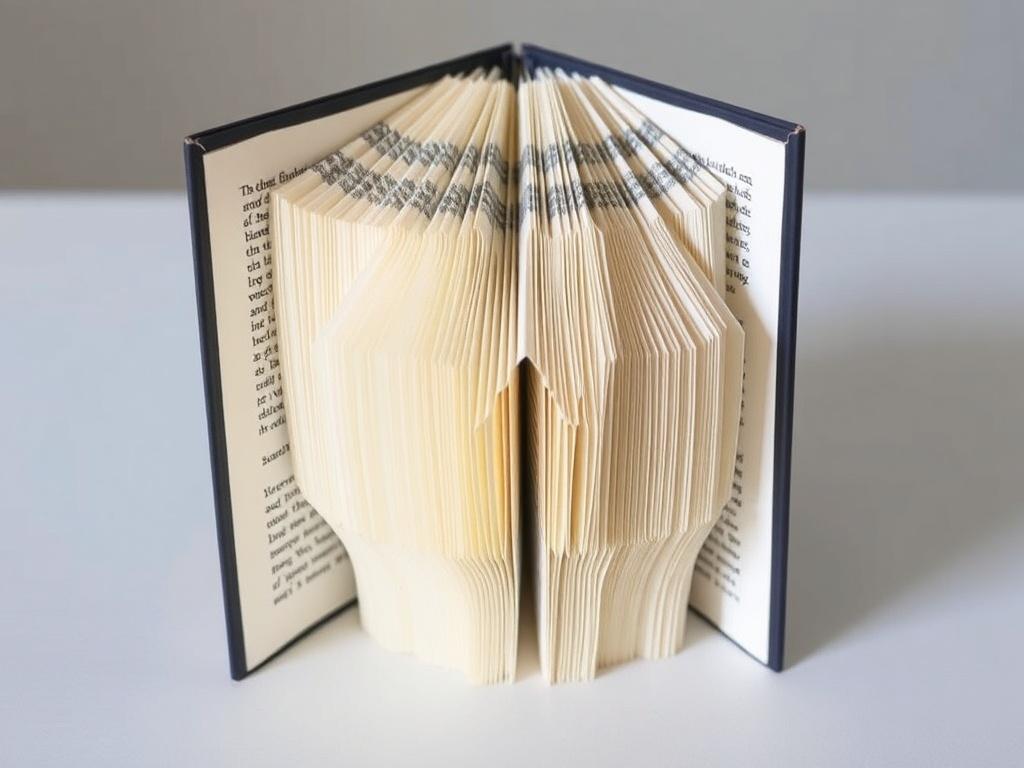
Folded books are delicate objects that respond to humidity, sunlight, and handling. Keeping them clean and protected extends both their appearance and structural integrity. Simple choices in display and care make a big difference over years.
Avoid prolonged direct sunlight, which fades paper and weakens fibers. Display pieces in stable, moderate humidity and dust them gently with a soft brush. If you expect heavy handling, consider sealing the folded edge with a light archival spray or placing the piece in a shadow box.
Styling and display ideas for the home
Folded books can play multiple roles in decor: focal points on a mantel, subtle shelf accents, or table centerpieces. Their handmade character pairs well with warm materials—wood, woven textiles, and ceramic. Think in terms of balance: one sculptural folded book can anchor a trio of objects, or two mirrored pieces can bookend a shelf.
Here are a few ways to incorporate folded books into different rooms:
- Living room: place a folded-word book vertically between bookends or horizontally as a stack topper.
- Bedroom: use a heart or script folded piece on a nightstand or dresser to add intimacy.
- Entryway: a skyline or city name folded from a locally-themed book makes a personal welcome.
- Dining: smaller folded books can act as place-card holders or understated centerpieces.
Gifts and personalization
Folded books make meaningful gifts precisely because they can be personalized. Names, initials, anniversaries, and simple icons translate beautifully into fold form. The time you spend measuring and folding becomes part of the message.
For gifting, choose a book that complements the recipient’s interests when possible. A vintage cookbook folded into a vegetable silhouette delights a home cook; a poetry collection repurposed into a heart feels quietly apt for a partner. Wrap the finished piece in tissue and a ribbon, and include a small card describing the book’s origin.
Troubleshooting common problems
Errors and frustrations are part of learning. A slipped measurement, an uneven spine, or pages that won’t lay flat can derail a project. Each problem has solutions and preventive measures, and learning them saves time later.
If letters look distorted, recheck page counts and confirm that you began at the center page. For pages that tear while folding, switch to a lighter touch or use a softer pencil grade for marking to avoid pressure. Reinforce weak spines with archival tape on the inside hinges if necessary.
Fixing a crooked design
A crooked design usually stems from miscounted pages or uncentered patterns. Identify whether the shift is lateral (left-right) or rotational (twist), then adjust by re-folding the affected section. Removing and redoing a handful of pages is tedious but far better than living with a misaligned final piece.
When the book’s center is uncertain, feel for the thickest point in the binding; that’s the safest anchor for symmetrical designs. Making an initial, faint center mark during setup prevents many alignment issues.
Safety and ethical considerations
Respect for books matters—especially if you source from libraries or used bookstores. Avoid defacing rare or historically valuable works. Many creators repurpose discarded or damaged books, which reduces waste and preserves desirable volumes in their original collections.
Use safe cutting and folding practices. Work on stable surfaces, cut away from your body, and keep fingers clear of blades. If you’re using chemicals like adhesives or sprays, ventilate the area and follow manufacturer guidelines.
Teaching others and community building
Sharing the craft enriches both teacher and learner. Workshops—whether in community centers, crafty meetup groups, or online livestreams—encourage experimentation and create connections. Teaching forces you to articulate methods clearly and exposes you to variations you might not have tried alone.
Online communities are particularly generous. Pattern swaps, troubleshooting threads, and before-and-after photos help newcomers avoid common obstacles. Community feedback also drives innovation, producing hybrid techniques and new tooling ideas.
Selling your folded books: pricing and presentation
Turning your hobby into a small business requires honest accounting of time and material costs. Successful sellers price by the hour plus materials, then factor in the emotional labor of customization. Presentation—photography, packaging, and clear product descriptions—affects perceived value as much as the work itself.
Think about limited editions and commissions. Limited runs of a popular word or motif can build demand, while custom commissions allow you to charge more. Keep a portfolio of high-quality images that show the piece closed, partially open, and at different angles to communicate its three-dimensional nature.
Real-life examples and my favorite projects
Early in my folding practice, I transformed a discarded hardcover travel guide into a city skyline for a friend who moved away. The skyline sat on her new mantel, and every time she visited she’d point and smile at the skyline’s tiny peaks—evidence that small, handmade items can hold real emotional currency.
Another project: a bookstore owner commissioned a series of folded-book initials to display behind the checkout desk. We matched the letters to the store’s color palette and placed soft LEDs behind them. The installation invited customers to lean closer, read the spines, and ask about the process, which in turn drove small workshop bookings.
Learning resources and where to find patterns
Patterns and tutorials abound online; search for beginner templates, time-lapse videos, and forums. Books and printable pattern databases provide reliable, tested charts that save you setup time. Local craft stores sometimes host workshops where you can learn in hands-on sessions and borrow instead of investing immediately in tools.
Keep a mental list of reliable resources: tutorial videos for visual learners, downloadable templates for precision, and community forums for feedback. Over time you’ll build a library of go-to patterns and tweak them to match your preferred page counts and aesthetic.
Practices that make you better, faster, and more consistent

Consistency comes from routine: measure twice, fold once, and rest your hands between long sessions. Use the same ruler and marking method so your eye becomes calibrated to those tools. Small habits—like numbering pages lightly before starting—prevent miscounts.
Speed follows familiarity. Don’t rush early projects; instead, aim for steady, deliberate movements. After a few books you’ll gain muscle memory for that satisfying rhythm: measure, fold, crease, repeat. That rhythm is as much part of the craft’s pleasure as the finished object.
Environmental considerations
Repurposing unwanted books is inherently sustainable, diverting paper from landfill into art. When sourcing materials, prefer donations, library discard sales, thrift stores, and broken or water-stained volumes unsuitable for resale. This minimizes the ethical dilemma of transforming potentially valuable books into decor.
If you use adhesives or sprays, choose archival, acid-free products where possible to extend the life of your piece. Reuse packaging materials for shipping, and consider offering a take-back or repair policy to keep folded books out of waste streams.
Expanding your practice beyond books
The sensibility behind page folding—turning a flat substrate into a three-dimensional object—translates to other materials. Paperboard, maps, sheet music, and even thin metal sheets can be folded into sculptural forms using similar principles. Exploring these materials widens your creative vocabulary and market possibilities.
For instance, folded maps make nostalgic gifts for travelers, while sheet music folded into musical notes can complement a musician’s studio. Experimenting with alternative substrates teaches you about tensile strength, fold memory, and texture—lessons that loop back and improve your book-folding work.
Where to go from here
Start with a small book and a simple pattern. Notice how your hands settle into the task; celebrate small wins like a perfectly centered heart or the first letter that reads clearly from the edge. Each project adds technique and confidence, and before long you’ll be designing your own templates and choosing color and light to enhance the folded forms.
The craft rewards curiosity. Try a different ratio of page counts to pattern size, play with shadow by changing display angles, and experiment with soft backlighting. The more you tweak, the more personal the work becomes—each piece a small manifesto of your tastes and patience.
Final thoughts on practice and pleasure
Book folding sits at an intersection: it’s mathematical, meditative, and domestic. The best folded pieces are those where the maker has allowed for small imperfections; those quirks reflect a human hand, not a machine. Keep your expectations generous, enjoy the pace, and let each fold teach you something new about shape, shadow, and story.
There’s satisfaction in watching a flat block of paper become a readable form, and there’s community when others notice and ask how you did it. If you pick up a ruler and a used hardcover today, you’ll be starting a craft that honors the past while making new beauty for the present.