
Embroidery has a way of slowing time down: a needle slips through a fiber, a tiny knot of color appears, and the world seems to rearrange itself around that stitch. In this guide I’ll show practical technique, creative approaches, and the small habits that separate occasional hobbyists from stitchers who make work that sings. Whether you’re relearning old favorites or chasing new textures, the pages ahead are designed to be both instruction and inspiration.
Why modern embroidery still matters
Embroidery used to be measured by samplers and household linens, but contemporary makers have reclaimed it as a flexible medium for storytelling, surface design, and slow craft. The modern practice borrows from fine art, fashion, and textile tradition to produce work that’s intimate and highly personal.
Beyond aesthetics, stitching teaches control, observation, and patience. It’s a portable craft that fits between other responsibilities and rewards incremental progress, which is why it often becomes part of daily ritual for many stitchers I know.
Finally, modern embroidery embraces experimentation. New threads, mixed-media, and digital-to-hand transfers have expanded what a stitched surface can be. This guide focuses on stitch technique, but also on how to think like a modern maker—layering, altering materials, and using negative space as deliberately as color.
Essential tools and materials
Before you start a project, assemble a small toolkit that suits both comfort and control. Key items include needles, a selection of threads, a couple of fabrics, a hoop, sharp scissors, and a marking tool you trust. Quality in these basics saves frustration later.
Needles matter: embroidery needles (crewel) have a sharp point and a long eye, while milliner or straw needles are longer and useful for couched or knotted work. Use a stranded cotton needle for general work and a tapestry needle if you stitch on evenweave for counted techniques.
Thread choices dramatically change texture. Stranded cotton is versatile; silk gives a sheen preferred for thread painting; perle cotton creates crisp, sculptural stitches; and metallics add sparkle but demand sturdier needles and slower stitching. I keep a spool of neutral perle and a set of stranded cottons in my kit for quick color experiments.
The right fabric supports the stitch. Linen and cotton muslin are forgiving and widely used; evenweave and aida are best for counted work; lightweight denim or canvas supports heavy threads and embellishments. Always prewash fabrics that may shrink or have finishes you don’t want to trap under stitches.
Quick reference: needles, threads, fabrics
The following table condenses the main pairings you’ll reach for when planning projects.
| Task | Needle | Thread | Fabric |
|---|---|---|---|
| General embroidery | Crewel/embroidery needle (size 7–9) | 6-strand cotton, separate as needed | Linen, cotton, broadcloth |
| Surface texture & perle | Chenille or crewel (size 3–5) | Perle cotton (size 5–12) | Canvas, denim, heavier linens |
| Thread painting | Sharp crewel (size 9–10) | Silk or fine stranded cotton | Fine linen, cotton poplin |
| Beads & metallics | Beading/crewel needle (thin) | Metallic thread, size 8–12 | Stable fabric with stabilizer |
Hooping, tension, and preparation
Proper hooping keeps fabric flat while you stitch but doesn’t require crushing the fibers. Aim for even tension without stretching the fabric like a drum. Too tight and the fabric will pucker when released; too loose and stitches will sit unevenly.
Stabilizers are essential with lightweight or stretchy fabrics, or when you add heavy embellishments. Tear-away and cut-away stabilizers both have uses: tear-away is perfect for temporary support, while cut-away remains for durability in items that will be washed often.
Transferring a design cleanly makes the stitching process smoother. I favor lightbox tracing for fine designs and water-soluble pens for quick motifs. Heat-transfer pens can be convenient but test carefully; some marks won’t fade after washing.
Fundamental stitches and how to use them
Learning a handful of stitches well is more useful than collecting many half-mastered techniques. Below are core stitches organized by function—lines, fills, knots, loops—that form the backbone of most projects.
For each stitch I include tips on direction, tension, and how to make it read like thread rather than punctuation. Practice them in small motifs before committing to a large piece.
Running stitch and backstitch: the skeleton of most designs
The running stitch is the simplest and most versatile: a series of even in-and-out stitches that form dashed lines. It’s perfect for sketchy outlines, basting, or creating subtle texture when multiple rows are placed close together.
Backstitch forms a continuous solid line and is essential for text, sharp outlines, and precise shapes. Keep the stitches short and the thread tension consistent to avoid a ropey look. For crisp curves, shorten the stitch length and slow down.
Split stitch and stem stitch: flowing lines with surface
Split stitch produces a chain-like texture when small stitches are worked so the needle splits the previous stitch. It’s excellent for organic outlines and a slightly rustic effect. Use a shorter stitch for tight curves and a longer one for smoother arcs.
Stem stitch (also called outline stitch) forms a ropey, slightly twisted line that sits well for botanical stems and lettering. It reads best when stitched in the same direction consistently, and you can vary the angle to change its twist and surface reflection.
Chain stitch and variations
Chain stitch creates loops that interlock, making it robust and decorative. It’s both structural and ornamental, and scaled up it becomes a bold border; scaled down it works like an airy rope. Detached chain, or lazy daisy, is a household favorite for small petals and leaves.
For a modern touch, try heavy chain with perle cotton as a graphic element on a jacket pocket. The stitch withstands wear and the raised profile adds tactile interest to a simple silhouette.
Satin stitch and long-and-short fills
Satin stitch is the go-to for solid, shiny fills. Work with long parallel stitches laid close together over a shape, and keep the tension even to avoid gaps. For curved edges, slightly vary stitch length so the stitches don’t bunch toward the middle.
Long-and-short stitch (often called thread painting) blends colors into realistic shading. Start with staggered long and short stitches across the area and layer additional passes to blend transitions. I once used this method to render a realistic moth on linen; the incremental layering of color felt like painting, but with tangible stitch texture.
French knots and bullion knots: controlled texture
French knots are tiny, tight knobs best for eyes, pollen, and textured ground surfaces. Use a short stitch length and hold the thread taut around the needle as you pull through; practice helps you make them consistently sized. If the knot becomes too big or loose, trim and start over—the line between charm and mess is small.
Bullion knots are longer, spiraled knots that can resemble buds or antennae. They require wrapping the thread multiple times and feeding the needle through those wraps; a common mistake is not keeping the wraps snug. It took me several sessions before I trusted bullion knots in a finished piece, but once I did they became indispensable for floral detail.
Seed stitch, fly stitch, and blanket stitch
Seed stitch scatters tiny stitches across a surface to create a textured fill that reads like stippling. It’s forgiving and very effective for backgrounds and foliage. Vary spacing and thread color for painterly effects.
Fly stitch forms a V-shaped element and is often used for leaves and branches. It’s quick and elegant, and by adding a small anchoring stitch below the V you can create stems or add stability for heavier threads.
Blanket stitch is both decorative and functional for edge finishing. It secures raw fabric edges and offers a graphic outline when worked in contrasting thread. It’s one of my go-to stitches for finishing hand-stitched pillows and textile art edges.
Herringbone, feather, and chevron stitches for texture
Herringbone stitch creates an interlaced ladder that looks woven. It’s excellent for borders and scaffolded fills that need a sense of movement. Work it with moderate tension so the crossovers sit flat and don’t pull the fabric.
Feather stitch is airy and perfect for vine-like patterns and implied motion. Stitched diagonally it adds a feathered texture that reads well from a distance. Pair it with small French knots to create complex botanical textures.
Chevron stitch is geometric and strong, lending itself to modern, repeatable patterns. Try it with perle cotton on coarse linen for a contemporary, graphic textile.
Couching and surface couching
Couching fastens a heavier thread or cord to the fabric using small stitches of a finer thread across it. It’s ideal for metallic threads or thick yarns that would be difficult to pull repeatedly. Couching makes bold lines and holds up well on wearables.
Surface couching uses decorative patterns of tiny stitches to secure laid threads in decorative ways. I used couching in a wearable collaboration once, threading gold braid across silk and anchoring it with contrasting silk thread to create a deliberately visible structure.
Blending, shading, and color strategies
Color is where embroidery shifts from craft to composition. A planned palette lets you create depth and mood—bright contrasts for bold graphic work, soft gradations for botanical realism. Think in layers: undercolor, midtones, highlights.
To blend threads, use long-and-short stitch and mix plies from different skeins. A common trick is to “split” the floss—use two strands of darker color with one strand of lighter color to ease transitions. Practice sampling blends on scrap fabric before committing to the main work.
Contrast and value matter more than hue alone. Two colors can be the same value and become invisible when worked together; check values in grayscale or squint to evaluate your composition. I often convert a photo to black-and-white to test if my planned stitches will read well at a distance.
Creating depth with stitch direction
Stitch direction influences how light catches the surface. Laying stitches to follow the form of an object—curving around a petal or radiating from a center—will give a sculptural quality. Deliberate direction changes can suggest contours more convincingly than color shifts alone.
For thread painting, mimic how a painter layers strokes. Begin with midtones, lay darker shadows with shorter strokes, and finish with highlights placed as tiny, bright stitches. Micro-highlights catch the eye and often make the piece feel finished.
Incorporating beads, metallics, and mixed media
Beads and sequins introduce reflected light and a tactile element that stands out in modern pieces. Be mindful of fabric weight and wear; beads add strain and may require a stabilizer and backstitch reinforcement. For clothing, place beads where friction is minimal.
Metallic threads offer drama but can be temperamental. Use a longer-eyed needle and work slowly to prevent fraying. Many stitchers prefer couching metallics rather than passing them through the fabric repeatedly, which preserves their sheen and reduces breakage.
Mixed-media approaches—appliqué, printed transfers, painted backgrounds—expand possibilities. I once layered painted linen with stitched outlines and bead accents to create a landscape that read as both painting and textile art. The result was more dimensional than either medium alone.
Design transfer, composition, and pattern development
Start with a simple sketch. Even a rough composition will guide stitch direction and color placement. Many modern stitchers begin with a loose graphite or ink drawing and then refine the layout on fabric using a lightbox or transfer paper.
Traceable designs can be drawn directly with water-soluble pens or heat-transfer pens; for complex work I print the design on soluble stabilizer and baste it to the fabric, stitching through both and removing the stabilizer at the end. This method prevents wandering lines and supports dense stitching.
Think in motifs and repeats when designing textiles. Small motifs become patterns for repeat printing or embroidery bands. For one-off pieces, compose around focal points and negative space to let stitched elements breathe.
Stitch order and layering strategies
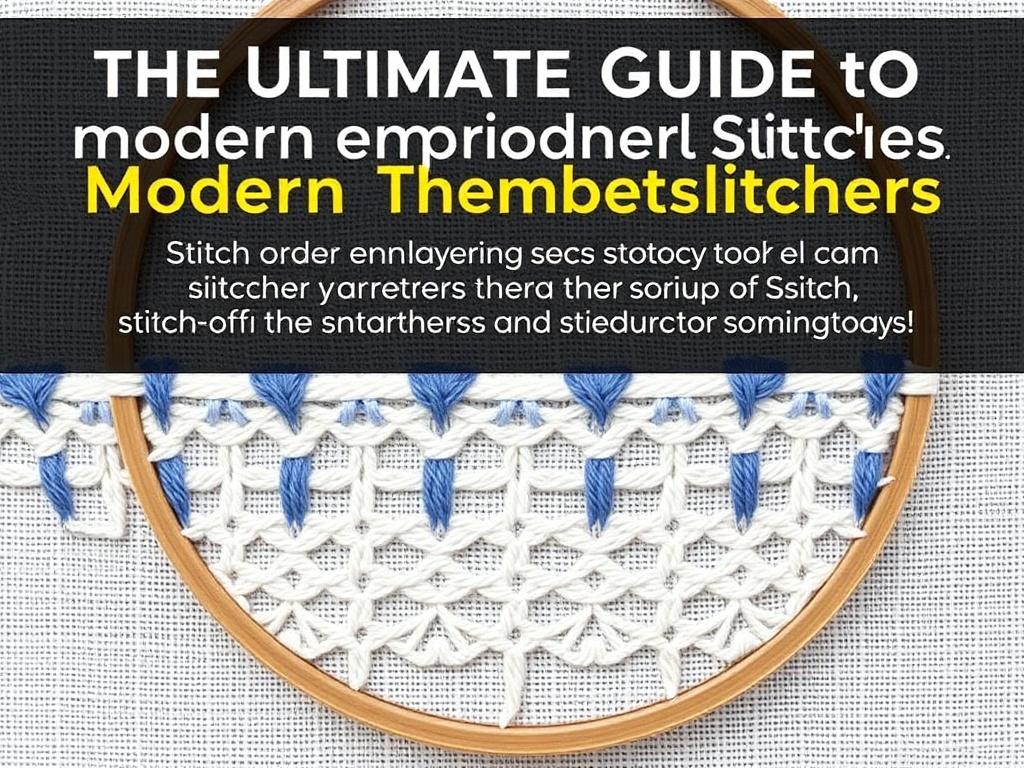
Layering matters: start with background fills, then midground details, and finish with the brightest highlights and surface embellishments. For botanical compositions, stitch stems and branches before attaching leaves and flowers to ensure structural coherence.
When mixing thread types, anchor foundational stitches with stable threads before adding delicate silk or metallics. This avoids pulling and helps the final surface sit cleanly. If you plan heavy beading, complete that after the main stitching so bead placement informs texture rather than competing with it.
Keep a mental map of stitch intersections and avoid crowding one area with heavy stitches that will compete visually. Space is as much a design choice as color—sometimes subtracting stitches clarifies the composition more effectively than adding them.
Finishing techniques and care
Finishing determines how a piece endures. For framed work, use acid-free backing and a mount that keeps the fabric taut without glueing directly to the threads. For wearable pieces, secure thread ends with small knots buried under stitches or with a dab of fray-preventing glue hidden in the seam allowance.
Hoop marks can be minimized by pressing the fabric lightly from the reverse after removing the hoop and by using a backing cloth between hoop and project. Steam pressing on the reverse with a pressing cloth will relax fibers and help remove impressions.
Hand wash embroidered garments gently in cool water with mild detergent and reshape while damp. Avoid scrubbing embellished areas and lay flat to dry. Proper care preserves both thread color and fabric hand.
Troubleshooting common problems
Puckering is usually caused by tension imbalance or too little support. Use a stabilizer for floppy fabrics, and check that your hoop is not overtightened. If puckering appears, gently press the area from the reverse and consider rehooping with a different tension.
Knots and tangles are often a sign of long thread lengths or poor thread conditioning. Cut your working length to about an arm’s length, and consider applying beeswax or thread conditioner for silky threads. Keep the tail of your thread anchored early in a seam to avoid long loose ends forming at the surface.
Uneven stitches come from inconsistent tension or changing stitch direction too abruptly. Slow down, practice stitch rhythm, and maintain consistent hand posture. Small, deliberate corrections compound into a finished surface that looks intentional rather than patched.
Practice projects and a six-week plan
Targeted practice builds confidence. Below is a simple six-week plan that progresses technique while producing usable outcomes: one small sampler each week focusing on a stitch family. This paced approach builds muscle memory and creative judgment.
- Week 1: Line work—running, backstitch, split stitch sampler on muslin.
- Week 2: Loops and chains—chain, lazy daisy, fly stitch floral panel.
- Week 3: Knots and texture—French knots, bullion, seed stitch mini landscape.
- Week 4: Fills and shading—satin and long-and-short stitch leaf study.
- Week 5: Surface effects—couching, metallics, beading on a pocket patch.
- Week 6: Composition—combine learned techniques into a 6″ finished piece.
Finish each sampler by photographing it and noting what worked and what didn’t. Over time these samplers become a personal reference library and a visual record of progress.
Sharing work, finding community, and continuing study
Embroidery communities are generous and practical. Join local guilds, online groups, or take workshops where you can see work in person. Critique and feedback accelerate learning in ways solitary practice cannot.
Follow makers whose work challenges you and replicate small sections to understand their techniques. I often dissect a favorite piece into stitches and palette, then attempt a modest study; it’s the fastest way to internalize someone else’s approach without copying their whole concept.
Books, short workshop classes, and online courses are abundant. Balance structured lessons with playful experimentation—structured learning gives you technique, but play teaches you how to break rules elegantly.
Your next stitch
Embroidery rewards patience and curiosity. Start with the stitches that interest you most, practice them until they feel like second nature, and then deliberately push them into new territory by combining materials and techniques. The craft is both a slow revelatory process and a fast path to small, daily rewards.
Take a photograph of one small area you enjoy and stitch a study of it. Use the sampler plan above if you want structure, or pick a tiny wearable—or a hoop to hang—that forces decisions about composition and finish. With every stitch you build not just a surface but a library of visual and technical choices you can draw on.
If you keep a small, well-curated toolkit and a habit of micro-practice, your stitches will soon carry an unmistakable voice—yours. Bring patience, curiosity, and a willingness to unpick when necessary, and the work you produce will reflect both craft and character.